
Garages, basements and shops across the Salt Lake Valley
Epoxy Flooring in Salt Lake City, UT
Coated concrete that leaves winter brine sitting on top, not soaking in, and stands up to the dry, sunny summers on the Wasatch Front.
- Free estimates on site: we measure your slab and inspect it in person
- A moisture reading on the slab before we put down a single coat
- A written quote that explains every surface prep step
Floors Built for Snowmelt and High-Desert Sun
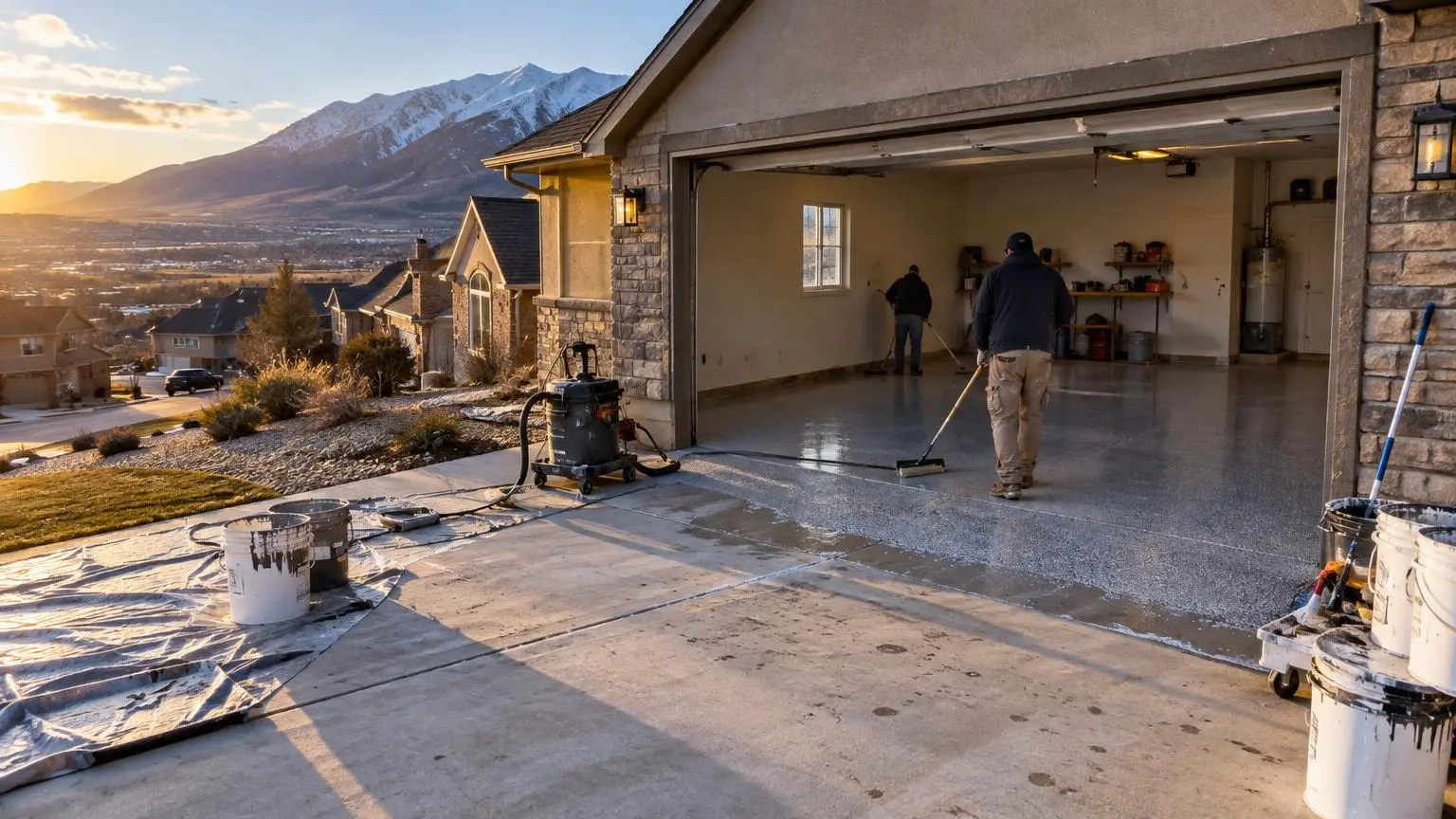
Epoxy flooring in Salt Lake City, UT gets tested by two very different seasons in the same room. From November into April, tires drag slush and road brine across the garage floor. By July the air is dry, the sun is strong and a slab near an open door can get hot to the touch. Epoxy Flooring Salt Lake City installs epoxy floor coating, polyaspartic, vinyl flake and metallic systems on garages, basements, workshops and business floors across the valley. We choose each system after we have tested the slab and asked how the space is used.
Winter is the real test
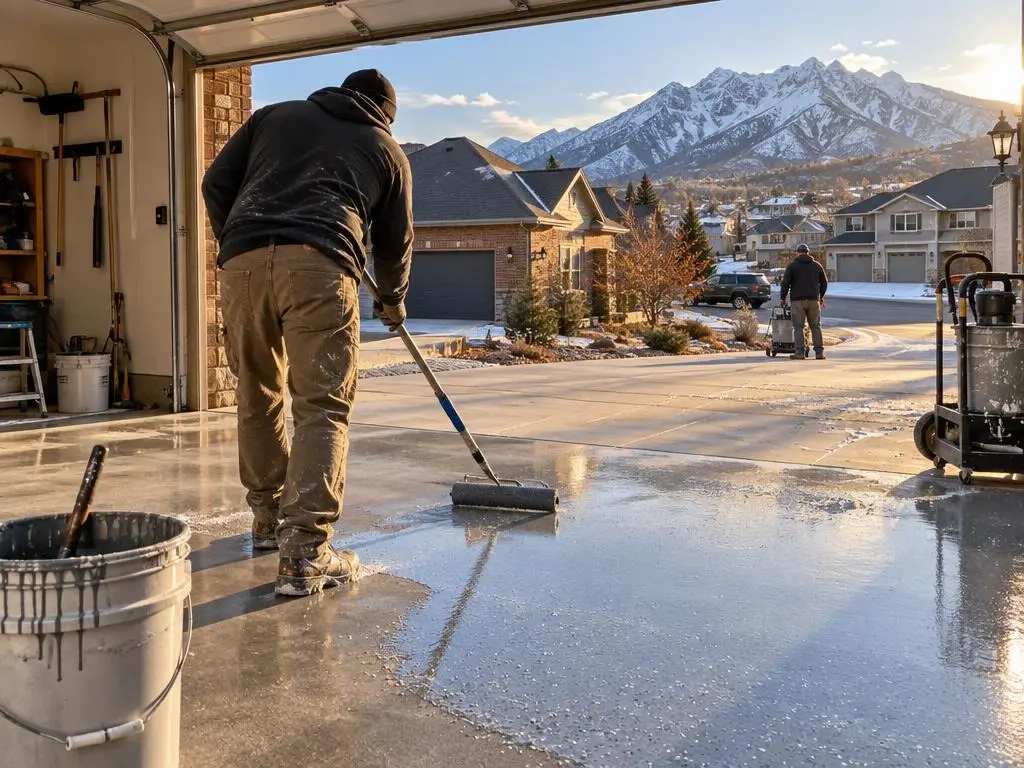
Salt Lake City averages about 127 days a year at or below freezing, and snow usually starts in early November and can keep coming into April. The Utah Department of Transportation reports spreading about 236,000 tons of salt on state roads over a winter season. Every car that pulls into a garage carries some of that home. On bare concrete, salty water soaks into the pores, freezes, thaws and slowly breaks off the top layer, a problem known as scaling. A sealed coating changes that. Brine stays on top, where a squeegee or a garden hose can push it out the door. On floors that take a lot of slush, we add extra texture near the entry so wet tires and boots have grip, and we use a topcoat that stands up to chemicals.
Summers are dry and bright
Average daytime humidity in July is around 22%, and a typical year brings about 56 days at or above 90 degrees. Dry air helps resin cure on schedule, which is a real advantage over humid coastal cities. Heat works the other way: a warm slab shortens working time and can leave roller marks if a crew rushes. When it is hot we begin at first light, mix resin in small batches and store it out of the sun. The city also sits at roughly 4,300 feet. On UV resistance, HomeGuide scores ordinary epoxy only poor to fair, while it gives polyaspartic an excellent mark, so a garage that faces west, or any floor that sees direct sun, gets a polyaspartic topcoat.
Old houses and old slabs
About a quarter of the city's housing units, 25.4% in recent Census survey estimates, were built in 1939 or earlier. In neighborhoods like the Avenues, which climbs a sloping bench above downtown, many garages are detached, narrow and decades old. Those floors often carry oil that has soaked in for years, a coat of porch paint, old patches or no vapor barrier underneath. Newer suburbs to the south and west have bigger attached garages with sound concrete, but even new concrete has a smooth, weak top layer that gives a coating no grip until a grinder opens it up. We diamond grind every floor, fill cracks and chips, and run a moisture test before we quote. The test result decides the primer.
Epoxy, polyaspartic or both?
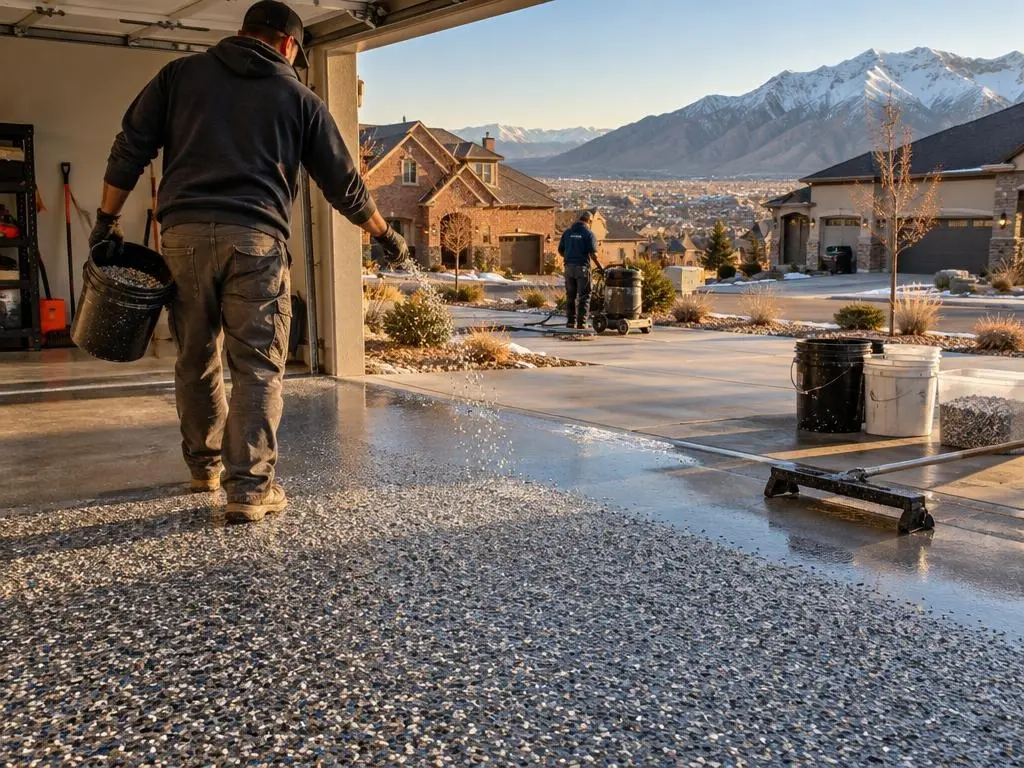
Most people searching for a garage floor coating are really choosing between these two resins. HomeGuide puts a single epoxy coat at 10 to 20 mils thick and a polyaspartic coat at 2 to 6 mils. Epoxy builds thickness, fills small pits and costs a little less. Polyaspartic cures much faster, in 1 to 2 days where epoxy can need as long as a week, and it does not yellow in sunlight. For many Salt Lake garages the practical answer is a blend: an epoxy base for build, a broadcast of vinyl flake, then a clear polyaspartic topcoat for UV and salt resistance. In a basement with no sunlight, an all-epoxy system is often enough. We explain the choice in the quote instead of selling one product for every floor.
What to ask epoxy flooring contractors
Plenty of epoxy flooring companies work the Wasatch Front, and the quotes can look alike on paper. These questions separate them:
- How will you prepare the concrete? Diamond grinding opens the surface. A quick acid wash or no prep at all is a common reason floors peel.
- Do you test for moisture before you quote? Older slabs and basements can push vapor up under a coating.
- Which products go down, how many coats and how thick?
- How do you handle cracks, spalls and control joints?
- How soon can I walk across it, return my shelves and pull a car in?
- Is every prep step and the total written down?
Good epoxy floor installers will answer all of these without hesitation. We put the answers in writing.
Epoxy flooring cost
Page one of a local search is mostly directories and forum threads, so here are the published national numbers we work from. For installed epoxy, HomeGuide gives $4 to $10 a square foot; polyaspartic comes in at $5 to $12. Its garage ranges for epoxy run $1,600 to $5,800 when the garage holds two cars and $2,300 to $8,600 for three cars. In Salt Lake City the biggest swings come from the slab itself: grinding off an old kit coating, repairing cracks in an older floor, or choosing a flake or metallic finish. We measure and test first, so your written estimate is the number you pay unless you approve a change.
The honest downsides
Epoxy is not perfect. High-gloss resin with no texture turns slippery once snow melts off a car, which is why we add texture or flake in garages. Plain epoxy yellows and chalks where sunlight hits it. It takes days to fully cure, and it will peel if it goes over a damp slab or poorly prepared concrete. Each of those problems has a known fix, and we build the fix into the system we recommend.
Basements and business floors too
Garages get most of the attention, but a large share of our work happens below grade and behind shop doors. Basements stay out of the sun and away from road salt, yet they sit against damp soil, so the moisture test matters even more there. Shops, warehouses, clinics and service bays need thicker systems, slip texture and phased schedules so the doors can stay open. Each service page below explains how we handle those floors.
Why Homeowners Call Epoxy Flooring Salt Lake City
Coatings chosen for brine and slush
On garage jobs we finish with a topcoat that resists chemicals and add extra grip by the door, so winter salt rinses off instead of soaking in.
Moisture tested before we price
Old slabs and basements are tested first, and the reading decides the primer. If a slab is too wet to coat, we tell you.
Ground, not just washed
Every floor is diamond ground with dust collection. That step is what lets a coating bond to the concrete.
One written price
The quote spells out your square footage, the prep, every coat and the price. Any change gets written down and signed off by you before work starts.
Common Questions
What does an epoxy floor coating cost per square foot?
HomeGuide puts installed epoxy nationally at $4 to $10 per square foot, with two-car garages at $1,600 to $5,800. Polyaspartic runs $5 to $12 a square foot. Removing old coatings, repairing cracks and adding flake or metallic finishes move the total, so we price each floor after we see and test it.
Are there drawbacks to an epoxy floor?
Plain epoxy can be slippery when wet, it yellows in sunlight, and it needs several days to cure fully. It also peels when it goes over damp or unground concrete. Texture, a UV-stable topcoat, a moisture test and proper grinding deal with each of those.
What is a better floor coating than epoxy?
For garages that see sun or a lot of road salt, polyaspartic often outperforms plain epoxy because it resists UV and cures in 1 to 2 days. Plenty of floors combine the two, with epoxy underneath for thickness and a polyaspartic topcoat for wear. For a basement out of the sun, epoxy alone usually does the job.
Can epoxy coating be applied to concrete floors?
Yes. Concrete is what these coatings are made for. The slab has to be ground, clean, repaired and dry enough, which is why we test moisture before quoting. We do not coat over wood, tile or vinyl.
Will road salt and deicers hurt a coated floor?
A sealed, chemical-resistant topcoat holds brine up on the surface so it never gets into the concrete. Rinse or squeegee the floor every so often through winter so salt does not sit for weeks. The coating protects the slab; the rinse keeps it looking clean.
Can you install a floor in winter?
Often, yes, but the slab and air have to be warm enough for the resin to set properly. A heated garage or basement can usually be coated most of the year. In a cold detached garage we may suggest waiting for milder weather or using a faster-curing system.
Is a DIY kit good enough?
HomeGuide lists DIY kits at $200 to $700. Most kits are thin and count on an acid etch where a grinder belongs, so they tend to peel under hot tires and winter brine. If a kit has already failed, it has to be ground off before a new system goes down.
Towns We Cover Along the Wasatch Front
We are based in Salt Lake City, and our crews coat floors in South Salt Lake, Millcreek, Holladay, Murray, Cottonwood Heights, Midvale and Sandy on the east side; West Valley City, Taylorsville, Kearns, Magna, West Jordan and South Jordan on the west side; Draper, Riverton, Herriman and Bluffdale toward the south end of the valley; and Bountiful, Centerville, Woods Cross and North Salt Lake to the north. We also travel to Lehi, Tooele and Park City. The floors are not the same across that map. The city and the older east-side suburbs have many pre-war and mid-century slabs that need more repair. The southwest has large, newer attached garages, often in planned communities with HOA rules. Benches and canyon mouths get more snow, and Park City gets far more. Open any town below for the housing and weather details we have gathered there.
- Epoxy Flooring in Salt Lake City, UT
- Epoxy Flooring in West Valley City, UT
- Epoxy Flooring in Murray, UT
- Epoxy Flooring in Sandy, UT
- Epoxy Flooring in Draper, UT
- Epoxy Flooring in South Jordan, UT
- Epoxy Flooring in West Jordan, UT
- Epoxy Flooring in Taylorsville, UT
- Epoxy Flooring in Holladay, UT
- Epoxy Flooring in Cottonwood Heights, UT
- Epoxy Flooring in Millcreek, UT
- Epoxy Flooring in Midvale, UT
- Epoxy Flooring in Riverton, UT
- Epoxy Flooring in Herriman, UT
- Epoxy Flooring in Bountiful, UT
- Epoxy Flooring in North Salt Lake, UT
- Epoxy Flooring in Woods Cross, UT
- Epoxy Flooring in Centerville, UT
- Epoxy Flooring in Magna, UT
- Epoxy Flooring in Kearns, UT
- Epoxy Flooring in South Salt Lake, UT
- Epoxy Flooring in Bluffdale, UT
- Epoxy Flooring in Lehi, UT
- Epoxy Flooring in Park City, UT
- Epoxy Flooring in Tooele, UT
Our Epoxy Flooring Services
Six coating systems for the concrete that Salt Lake households and businesses rely on, from salt-soaked garages to basements, studios and work floors.
Epoxy Garage Flooring
Garage slabs we grind, patch and coat so winter brine, hot tires and dropped tools do little harm.
Learn more →Flake Garage Floors
Vinyl chip broadcast floors that hide salt film, dust and tire tracks and give your feet more grip.
Learn more →Polyaspartic Floors
Quick-curing coatings that stay color-stable in UV, so you park sooner and the floor keeps its look in strong sun.
Learn more →Metallic Epoxy Floors
Poured, hand-worked epoxy with metallic pigment that reads like polished stone or moving water.
Learn more →Commercial Epoxy Floors
Thicker, chemical-resistant floors for shops, warehouses, clinics, kitchens and service bays.
Learn more →Basement Floor Epoxy
Moisture-tested, sealed basement floors that clean easily and turn bare concrete into usable space.
Learn more →Book a Free Floor Estimate
We visit, measure, test your slab and hand you a written price. Salt Lake City and the towns around it.